If you are looking for the steps, here they are. What follows is the process as the Minnesota Department of Commerce lays it out for homeowners, in the state's order, with the state's wording where it matters. After that we explain the narrow part a roofing contractor plays in it, and the part we are not allowed to play.
We are deliberately not the source for the insurance half of this page. Minnesota Statute 325E.66 says a residential contractor may not interpret policy provisions, may not advise an insured about coverage or about duties under a policy, and may not adjust a claim on the insured's behalf, unless that contractor is also licensed as a public adjuster. We are not licensed as one, so we point you at the people who are and at the agency that regulates them.
The full guidance is at mn.gov/commerce. Read it there too. This page is a summary, and the state's own page is the authority.
The steps, as Minnesota Commerce gives them
- Call your insurance agent and report the loss. Commerce puts this first. If you do not have an agent, call your insurance company directly to report it.
- Make sure the area is safe and secure. Commerce says not to put yourself at risk if local authorities have not allowed public access, and to shut off the electricity if the structure is safe to enter.
- Document the damage before you clean up. Take pictures or video. Commerce is emphatic that it is very important to document all of the damage.
- Do not throw things out yet. Commerce says to avoid discarding anything, other than perishable food, until you meet with the adjuster, who will help determine what can be discarded.
- Make temporary, inexpensive repairs to prevent further damage. Commerce gives boarding up broken windows and placing a tarp over a damaged roof as its examples, and warns that otherwise additional damage may not fall within your policy. Keep receipts for materials you buy so you can be reimbursed.
- Keep your policy and claim number to hand, which Commerce says helps the process move faster.
- Take notes. Keep a log of who you spoke to and when, with a summary of the conversation, and ask questions when instructions are not clear.
- Make a home inventory. Commerce suggests using your phone to photograph or video the home and belongings, or writing a list from memory if you could not do it beforehand.
- Wait for the company's adjuster. This is the step homeowners most often get backwards. Commerce says not to call anyone to repair or replace your loss without first getting instructions from your insurance company's adjuster, because the insurer may need to inspect before repairs are made.
- Get organized. Commerce recommends getting a complete copy of your policy or contract, collecting records that prove the value of damaged property, and keeping a log of expenses and of contacts with the company.
Notice what is not on that list. There is no step where a roofing contractor files anything, submits anything, or speaks to the insurance company for you.
What Commerce says to ask the adjuster
When the company's adjuster comes out to assess the damage, Commerce says to ask for:
- A business card or identification.
- Information about what you are required to do next.
- Information about what the company will be doing next.
- Instructions on getting estimates for repairs, and clarification about whether that is your responsibility or theirs.
- A time estimate for how long the adjuster expects the settlement process to last.
- Additional living expenses, if you cannot stay in the home. Commerce notes that cashing an advance for temporary living expenses will not affect the final settlement, and that you should keep receipts.
Write the answers down. Commerce recommends keeping that log for a reason.
Where a roofing contractor actually fits
Our part is the roof, and it is a real part. Here is the whole of it.
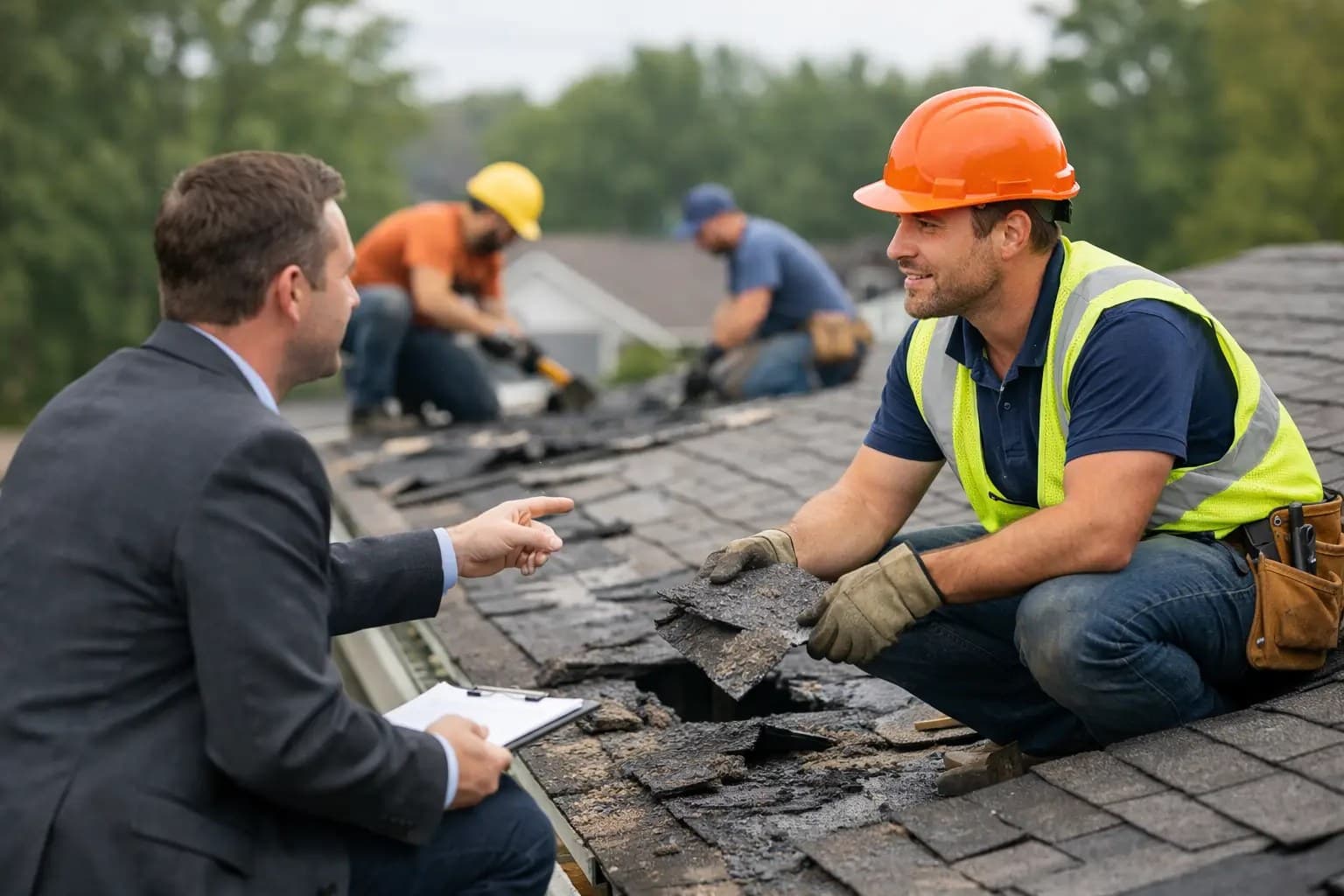
We inspect and document. We get on the roof, photograph what we find, and give you a written report: which slopes are affected, what the damage looks like on the shingles and on the soft metals, the age and condition of the roof, and where any water is getting in. That report is yours. Take it wherever you like.
We give you an itemized estimate. Tear-off, disposal, underlayment, ice and water shield, flashing, ventilation, the shingle itself, labor. Line by line, so the number is checkable rather than a lump sum.
We come to the adjuster visit if you want us there. Not to argue the claim. To be the person who can answer construction questions on the spot: what that soft metal dent means, why a valley was built the way it was, what is under the shingles on that slope.
We build the work you hire us to do. That is the job.
What we will not do, and why you should be glad
We will not interpret your policy or tell you what it covers. We will not predict what your insurer will decide. We will not advise you on filing, on timing, or on any duty you have under your policy. And we will not pay, rebate or absorb any part of your deductible, which Minnesota Statute 325E.66 makes illegal for every residential contractor in this state.
A roofer who does those things is either guessing at a document they have not read or doing work the state reserves for licensed adjusters. The confidence sounds reassuring in a driveway. It is worth nothing later, and it can complicate the very thing you were hoping it would help.
If the outcome is not what you expected
Commerce publishes guidance for that too, and again it is the state speaking rather than us.
Commerce says to review the terms of your coverage first, because policies are specific about the perils they name and about their exclusions. If there is a disagreement about the settlement, Commerce says to ask the company for the specific policy language in question. If a claim is denied, Commerce says to ask for a written explanation detailing the reason and the specific policy language it rests on. And Commerce says not to rush into a settlement: if the first offer does not meet your expectations, be prepared to negotiate.
Public adjusters, and the people pretending to be one
Commerce describes one option we cannot be. A public adjuster is someone you may pay to help document losses, who can represent you in dealings with the insurance company's adjuster, and who is typically paid a percentage of the final settlement. Commerce is clear that you are not required to work with one.
If you are considering it, Commerce says to check whether they are registered with the Minnesota Department of Commerce and whether they have any previous disciplinary action, to get a written contract that clearly identifies all fees, and to decide whether the help will recover enough to offset the fee.
Commerce also warns that scammers take advantage of these situations. Its warning signs are people who claim to be from a government agency, insist their services are mandatory, use high-pressure sales tactics, or refuse to provide a written contract. Every one of those is worth remembering when someone knocks on your door the week after a storm.
The one thing we will say plainly
Get the roof looked at and photographed by somebody who does this for a living, and get an itemized number. That document is useful in every version of what happens next, including the version where no claim is involved at all.
Roofs R Us holds Minnesota license BC740619 and has been BBB A+ accredited since 2008. Ask for a free roof inspection and we will bring you the photographs and the estimate.
← Back to all posts