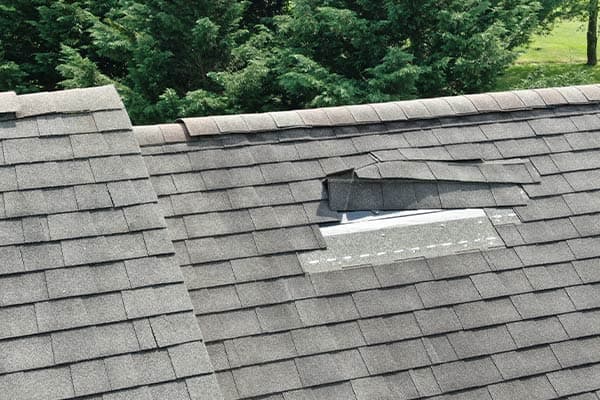
Hail gets the headlines. Wind does more roof damage in the Twin Cities than most people realize, and a lot of it goes unnoticed until water shows up inside.
I'm Luke. Between the June 19 storm, the derecho-style lines we get out of the west every summer, and the ordinary 50 mph fronts that come through in April and October, we inspect wind damage in Blaine, Brooklyn Park, Maple Grove, and Coon Rapids year-round. This is what wind does to a roof, what to look for, and how to handle it.
Need this handled? See our storm damage restoration service.
Storm Damage Restoration in the Twin CitiesHow wind actually damages a shingle roof
A shingle roof stays on the house because of two things: nails, and a strip of factory adhesive on the underside of each shingle that bonds it to the one below after a few warm days. That seal strip is what turns a stack of loose tabs into a single sheet that wind flows over.
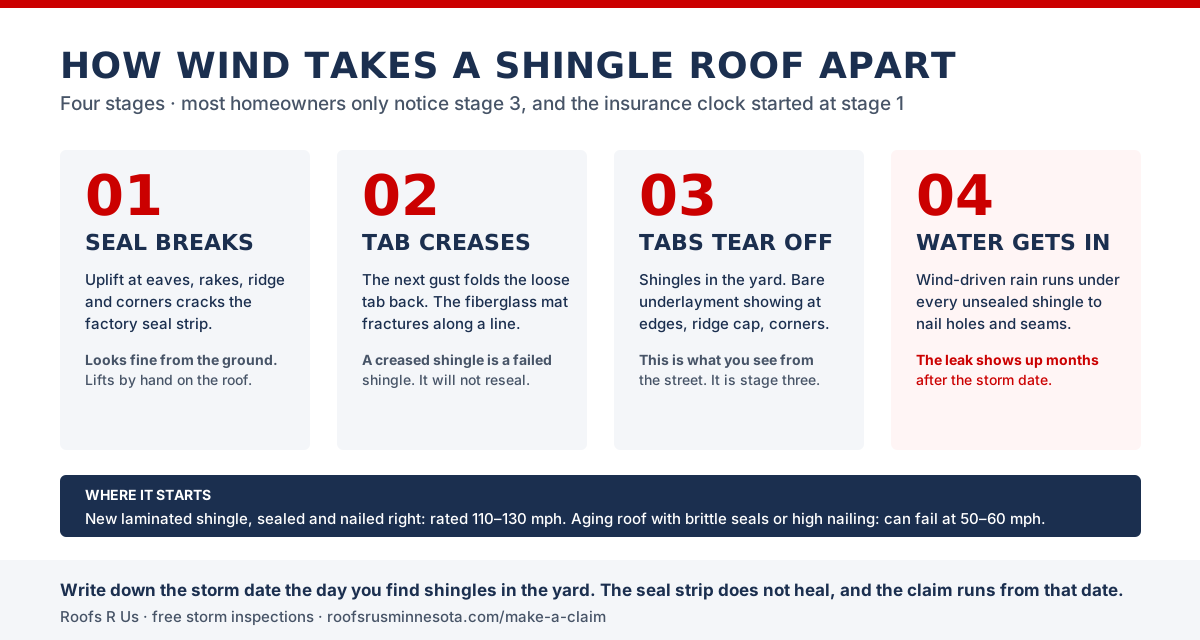
Wind attacks the seal. Here is the sequence:
Uplift breaks the bond. Wind hitting the roof edge creates suction on the top surface. On the windward eave, the rake edges, the ridge, and the corners, that suction lifts the front edge of the shingle. Once the seal strip cracks, the shingle is loose even if it lies back down.
The loose shingle creases. The next gust folds the unsealed tab back over itself. That leaves a horizontal crease line across the shingle where the fiberglass mat fractured. A creased shingle is a failed shingle. It will not reseal, it sheds granules along the crease, and it will tear off in a later, smaller wind.
Then tabs go. Missing shingles are the last stage, not the first. By the time you can see bare underlayment from the street, the shingles around that spot have usually been loose for a while.
Then water. Wind-driven rain gets under every unsealed shingle and finds nail holes, seams in the underlayment, and the top of the ice-and-water shield.
The wind speed that starts this depends on the roof, not the forecast. A new laminated shingle with a bonded seal, nailed in the nail zone, is rated for 110 to 130 mph. A 15-year-old roof with brittle seals, or one that was nailed high by a sloppy crew, can start losing tabs at 50 to 60 mph. That is why one house on your street loses half a slope and the one next door looks untouched.
The signs, from the ground and from the roof
From the ground, safely:
- Shingle tabs or pieces in the yard, gutters, or the neighbor's yard downwind
- Bare spots where you can see black underlayment or the dark asphalt of the shingle below
- Ridge cap shingles lifted, torn, or missing along the peak
- Shingles that look "wavy" or lifted along the edges facing the direction the storm came from
- Loose or bent metal at the drip edge, gutters pulled away, damaged soffit panels
- A flag of underlayment flapping at a rake edge
From the roof, which is our job, not yours:
- Creased shingles, which show as a straight horizontal line partway up the tab, sometimes with a granule loss line
- Shingles that lift by hand with almost no effort, meaning the seal strip is broken
- Exposed or backed-out nails where the shingle above lifted
- Tears at the nail line
- Flashing lifted at walls and chimneys
- Debris impact damage from branches
A good inspection maps it that way, because the pattern of the damage is what tells you whether a storm did it or the roof is simply worn out.
Storm damage or wear, and where the insurance question goes
The pattern is what separates the two, and pattern is something a roofer can legitimately speak to.
What a wind event looks like: creasing and broken seals concentrated on the slopes, edges, ridges and corners that faced the storm, while the rest of the roof is still bonded. Shingle pieces in the yard downwind. Ridge cap lifted along the peak. Damage that runs in a direction rather than scattered evenly.
What ordinary wear looks like: loose tabs spread across every slope regardless of which way it faces, shingles that never sealed because they went on in cold weather and never bonded, curling and granule loss across the whole field, and brittleness everywhere rather than in one band.
We map which one your roof shows, slope by slope, and hand you the photographs. What your insurer makes of that is between you and your carrier, and we do not guess at it. Minnesota Statute 325E.66 bars a residential contractor from interpreting policy provisions, from advising an insured about coverage or about duties under a policy, and from adjusting a claim, unless that contractor is also licensed as a public adjuster. We are not.
Anything about your own policy belongs with your agent or your carrier. The Minnesota Department of Commerce publishes plain guidance for homeowners after a property loss at mn.gov/commerce, and it says the first step after a loss is to call your insurance agent and report it, or the insurance company directly if you do not have an agent.
One thing worth knowing about the building itself: a broken seal strip does not heal. Every wind after the first one works on the same loose shingles, so a wind-damaged roof keeps deteriorating while it sits there. That is a fact about asphalt, not a statement about your policy.
Repair or replace
Repair makes sense when the damage is limited to a few shingles or one edge, the surrounding shingles are still bonded, and the roof has years left. We remove the creased tabs, weave in matching shingles, and hand-seal every tab we touch with roofing cement so it bonds immediately instead of waiting for a warm week. On a Duration roof we can usually get a close color match. On a 15-year-old discontinued shingle, the patch will show, and we will tell you that.
Replacement makes sense when creasing runs across a slope, when shingles lift by hand across most of the roof, or when the roof was already near the end. Patching a roof where every remaining shingle is loose is throwing money at the next storm.
If you are replacing, this is the moment to think about wind rating. Owens Corning Duration with the SureNail strip is rated to 130 mph, and correct nailing in that reinforced zone is most of what keeps it there. Ask any roofer you are considering what wind rating the shingle carries and how many nails per shingle they use. Four is standard. Six is the high-wind pattern, and on exposed lots it is worth asking for.
What to do the day after a windstorm
- Report the loss. Minnesota Commerce says the first step is to call your insurance agent and report it, or to call the insurance company directly if you do not have an agent.
- Note the date and time. Check the National Weather Service report for your area and save it.
- Walk the yard. Photograph any shingle pieces, ridge cap or debris before you clean up. Commerce is emphatic that documenting all of the damage before cleanup matters.
- Look up, from the ground. Photograph anything lifted, missing or wavy, and do not get on the roof. If a whole slope has gone, the photographs will show exactly what is happening up there.
- Check the attic with a flashlight for daylight, wet sheathing or fresh staining.
- If water is coming in, stop it. Commerce tells homeowners to make temporary, inexpensive repairs to prevent further damage, and gives placing a tarp over a damaged roof as its own example. Keep the receipt for anything you buy.
- Get the roof inspected properly by someone working with fall protection, and get the findings in writing with photographs.
Request a free inspection and we will map the damage slope by slope, tell you plainly whether it is a repair or a replacement, and put it in a written report with photographs that is yours to keep.
← Back to all posts