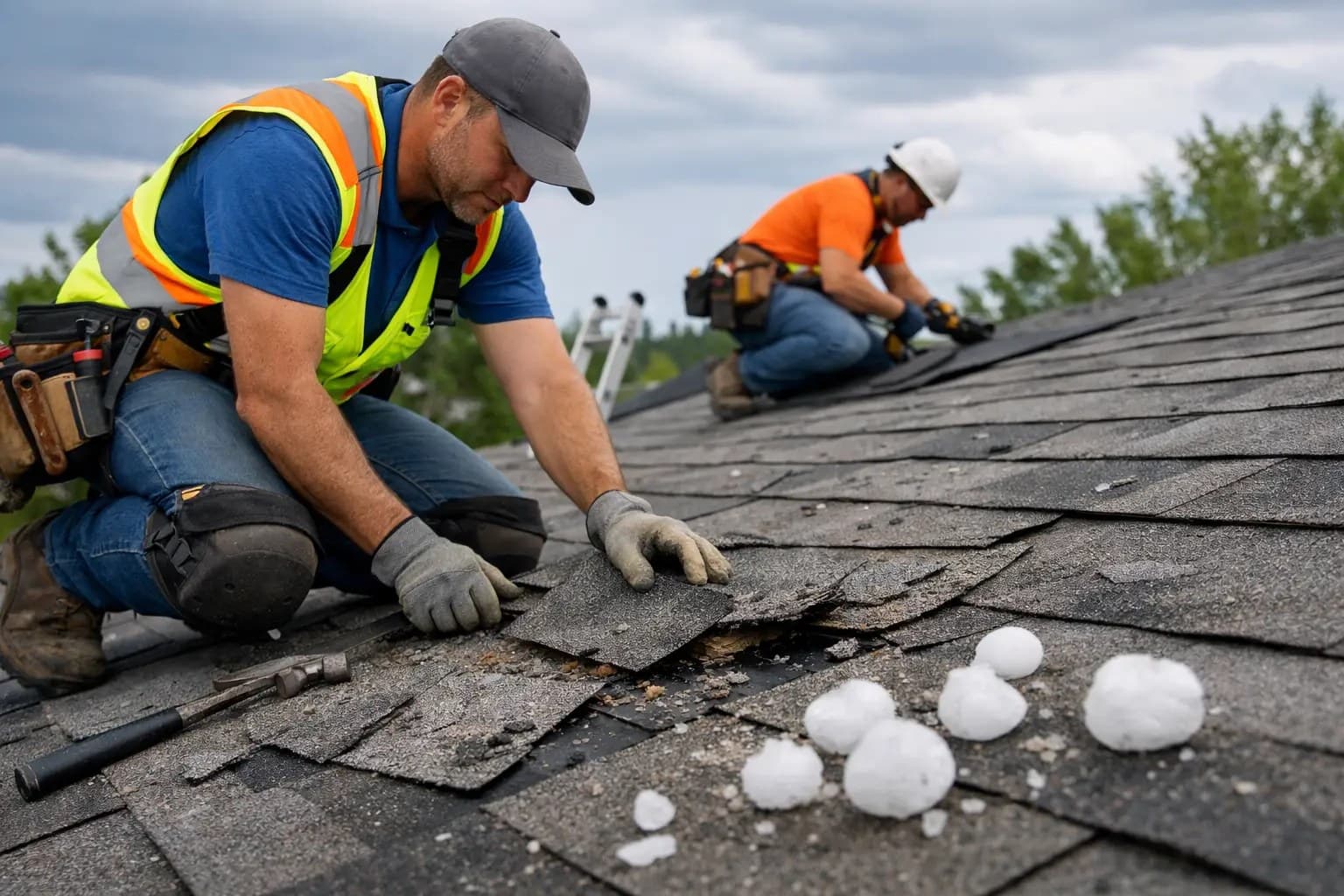
Hail comes through the north metro most summers, and afterwards the same two questions turn up on every driveway. Is my roof actually damaged, and what happens next?
We can answer the first one, because that is a question about a building. The second one splits in half: the insurance half belongs to your agent, your carrier and the Minnesota Department of Commerce, and the construction half belongs to us. This guide keeps those two halves apart on purpose, because a roofing contractor mixing them up is how homeowners get bad information delivered with a lot of confidence.
I am Luke. We have inspected a great many hail-struck roofs across Blaine, Coon Rapids, Andover, Ham Lake and the rest of the north metro, including after the June 19, 2026 storm. Here is what that work has taught us, and where we stop.
What hail actually does to a roof
Hail damage is often a bruise rather than a hole. That is the single most useful thing to understand, because it explains why almost nobody spots it from the driveway. Larger or wind-driven stones can tear or puncture a shingle outright, which is easier to see but no less serious.
A stone lands on an asphalt shingle. The granules scatter at the point of impact, leaving a dark spot where the asphalt shows through. Underneath, the fiberglass mat fractures. The shingle is still lying flat and still looks like a roof. What has changed is that the mat is broken and the asphalt is now exposed to ultraviolet light, so the spot sheds more granules, bakes, and eventually opens up. That is why a June storm can produce a leak the following spring.
A hail bruise, up close, is a soft dark circle roughly the size of the stone, and it gives very slightly under a thumb. It is fresh: the exposed asphalt is dark rather than weathered grey. Age is one of the ways an experienced eye separates a new hit from ordinary granule loss.
The soft metals tell the clearest story
Shingles are ambiguous. Metal is not. Aluminum gutters, downspouts, vent caps, roof jacks, the furnace flue and any metal fascia take a dent and hold it. Soft metal tells you the size of the stones, which direction they came from, and which slopes took the worst of it. On most inspections the metals are the first thing we photograph, before we look at a single shingle.
The same is true at ground level. Dented air conditioner fins, pocked deck boards, a dinged mailbox and shredded hosta leaves are all part of the record.
What size hail matters
Small hail, up to about three quarters of an inch, mostly bounces off a healthy laminated shingle. Stones from an inch upward start bruising ordinary asphalt shingles, and the older and stiffer the shingle, the less it takes. A twenty-year-old roof can be marked by hail that leaves a five-year-old roof alone, because old asphalt has lost its flexibility and fractures instead of absorbing the hit.
If you want to know what actually fell at your address on a given day rather than what someone tells you fell, the National Weather Service Storm Prediction Center publishes daily storm reports. The June 19, 2026 north metro event is in the Storm Prediction Center report for that date.
What you can check yourself, from the ground
Please do not get on the roof. A hail-struck roof is covered in loose granules, which behave like ball bearings, and no photograph is worth the fall. From the ground and from inside, you can still find a great deal:
- Walk the perimeter and look at the gutters and downspouts, at eye level, for dents.
- Look at vent caps, the furnace flue and any metal trim.
- Check whether there is a heavy line of granules in the gutters or at the bottom of the downspouts.
- Look at the air conditioner fins, the deck, the fence and the siding, especially on the side the storm came from.
- Go into the attic with a flashlight and look for daylight, damp sheathing or fresh staining.
- Photograph all of it, with dates.
Then have someone get on the roof properly, with fall protection, and photograph what is actually up there.
The insurance side, in the state's words rather than ours
Minnesota Statute 325E.66 says a residential contractor may not interpret policy provisions, may not advise an insured about coverage or about duties under a policy, and may not adjust a claim on the insured's behalf, unless that contractor is also licensed as a public adjuster. We are a roofing company, not a public adjuster, so the following is a summary of what the Minnesota Department of Commerce tells homeowners, not advice from us.
Commerce says the first step after a loss is to call your insurance agent and report it. If you do not have an agent, call the insurance company directly. After that, Commerce tells homeowners to make sure the area is safe, to take pictures or video before cleaning up and to document all of the damage, to avoid throwing things out until they meet with the adjuster, and to make temporary, inexpensive repairs to prevent further damage while keeping the receipts for materials so they can be reimbursed.
Commerce also says something that catches a lot of people out: do not call anyone to repair or replace your loss without first getting instructions from your insurance company's adjuster, because the insurer may need to inspect first.
When the adjuster arrives, Commerce says to ask for identification, for what you are required to do next, for what the company will be doing next, for instructions on getting repair estimates, and for a time estimate on the process. If there is a disagreement about the settlement, Commerce says to ask for the specific policy language in question, and if a claim is denied, to ask for a written explanation naming the policy language it rests on. Commerce also says not to rush into a settlement that does not meet your expectations.
All of that is at mn.gov/commerce, and it is worth reading in full at the source.
The people who show up after the storm
Hail brings out-of-state crews to Minnesota within days. Some are fine. Some are not, and Commerce publishes its own warning signs. It says to be wary of anyone who claims to be from a government agency, insists their services are mandatory, uses high-pressure sales tactics, or refuses to provide a written contract.
Add one of ours, which is a matter of law rather than opinion. If someone offers to take care of your deductible for you, that is not a discount. Minnesota Statute 325E.66 makes it illegal for a residential contractor in this state to pay, waive, rebate or absorb any part of an insurance deductible. Someone breaking that law in your driveway on day one is telling you what the rest of the job will be like.
Our storm chaser red flags guide goes through the rest of them.
What we do on a hail-damaged roof
We get on the roof and photograph what is there: the slopes, the bruising, the soft metals, the flashing, the ridge, the age and condition of the shingle. We give you a written report and an itemized estimate, line by line, so the number is checkable. We will come to the adjuster visit if you want us there, to answer construction questions on the spot. And we build the work you hire us to do.
We do not interpret your policy or tell you what it covers. We do not predict what your insurer will decide. We do not advise you on filing or on timing. That is not caution for its own sake. It is the line the statute draws, and a roofer who ignores it is not being helpful, only confident.
Roofs R Us holds Minnesota license BC740619 and has been BBB A+ accredited since 2008. If hail came through your neighborhood, ask us for a free roof inspection and we will bring you photographs and a number. Our storm damage page covers what the work itself involves.
← Back to all posts