
In the days after the June 19 hail storm I drove through a Blaine subdivision and counted yard signs from roofing companies I had never heard of, several with out-of-state area codes printed on them. By the end of the summer some of those companies were no longer around.
That happens after every big hail event in the Twin Cities, and it is the part of a storm that does the most lasting damage. The hail cracks your shingles. The wrong contractor takes your insurance money, puts a mediocre roof on your house, and is gone before the first leak.
I'm Luke, and I own Roofs R Us. We are a Blaine company and we are not going anywhere. This is what I tell neighbors, in order, about telling a storm chaser from a roofer who will still answer the phone in 2036.
Need this handled? See our storm damage restoration service.
Storm Damage Restoration in the Twin CitiesWhat a storm chaser actually is
A storm chaser is a roofing operation that follows weather. A hail event hits Blaine, Coon Rapids, Andover, and Ham Lake, and within days a company that was in Oklahoma last month has a rented office, a stack of yard signs, a local phone number that forwards to a call center, and a crew of door-knockers on commission. They sign as many insurance jobs as they can through the fall, install them with subcontracted labor, collect the checks, and move to the next storm.
Some of that work is fine. Some is not. The problem is the same either way: the warranty is only as good as the company standing behind it, and the company is not going to be here. When a pipe boot fails in year three, or the city never got a permit, or the workmanship warranty needs honoring, there is nobody to call.
Minnesota has seen enough of this that the Department of Labor and Industry issues a public reminder after major storms. Here is what they tell homeowners to check, plus what I have seen at a lot of adjuster meetings.
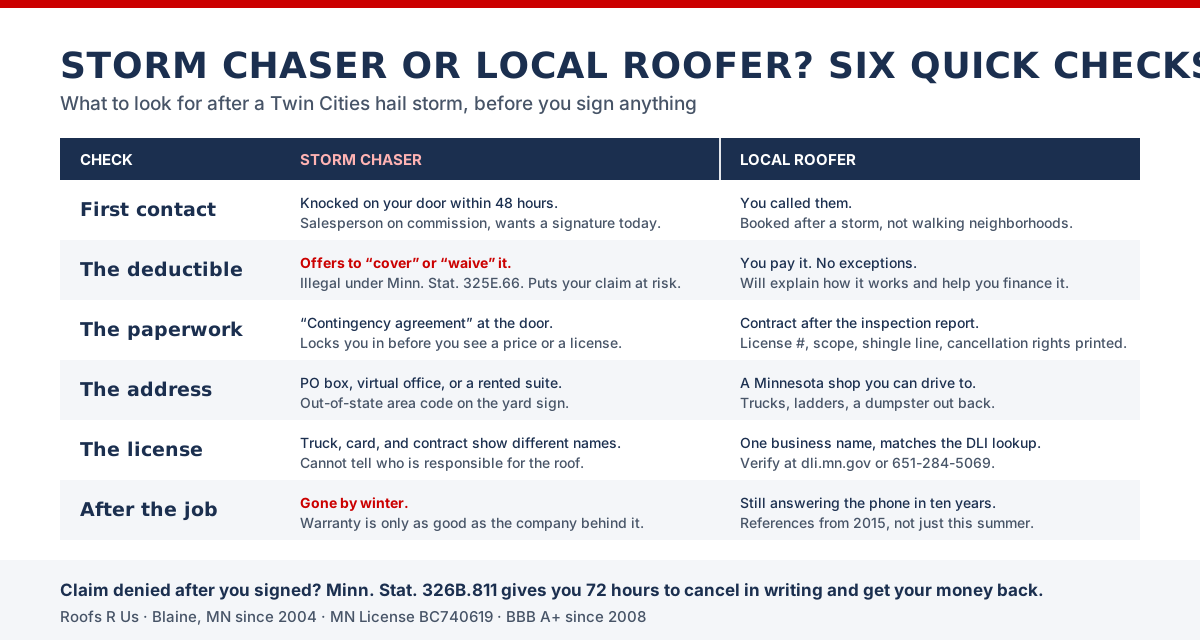
The nine red flags
1. They knocked on your door. Not automatically disqualifying, but it is the first filter. Established local roofers are booked after a storm. They are not walking neighborhoods. Door-knockers are on commission and their job is to get a signature today.
2. They offer to cover your deductible. This is not a discount. It is a crime. Minnesota Statute 325E.66 prohibits a contractor from paying, waiving, rebating, or absorbing your deductible in any form, including "we'll find a way" or an inflated invoice that hides it. The statute also covers offers of compensation for letting a contractor inspect the property, for making a claim, or for referring their services to others. A contractor willing to break that law in the first conversation is telling you how they operate. And 325E.66 goes further: it states that if a residential contractor violates the section, the insurer to whom the claim was tendered is not obligated to consider that contractor's estimate.
3. They want you to sign something at the door. A "contingency agreement," an "inspection authorization," a "letter of intent." Read the DLI's own words: if you sign a piece of paper, it is a contract. Contingency agreements commonly commit you to that company for the full insurance scope before you have seen a price, checked a license, or spoken to your agent.
4. The truck, the sign, and the contract show different names. A license belongs to a business entity. If the yard sign says one thing, the salesperson's card says another, and the contract has a third LLC on it, you cannot tell who is actually responsible for the roof.
5. There is no Minnesota address, or the address is a PO box or a virtual office. Ask where the shop is. Ask to see it. A local roofer has a physical location with trucks, ladders, and a dumpster out back.
6. They "did your neighbor's roof" but cannot give you the neighbor's name. Or the references are all from this summer. A company that has been here a long time has references from years back, not only from this summer.
7. They tell you what the insurance company will pay before anyone has been on your roof. Nobody knows that, and a residential contractor is not permitted to say it. Minnesota Statute 325E.66 bars a contractor from interpreting policy provisions, advising you about coverage or about duties under your policy, or adjusting a claim for you, unless they hold a public adjuster license. A real inspection produces photographs and a scope. It does not produce a promise.
8. They hand you an authorization to start repairs without an itemized estimate. Minnesota Statute 325E.66 says a residential contractor may not give an insured an agreement authorizing repairs without also providing a good faith estimate of the itemized and detailed cost of services and materials. No itemized estimate, no signature.
9. They want to be paid in full before the work starts, or paid in cash. A deposit is normal. Full payment before a shingle is delivered is not.
Minnesota law is on your side. Here is what it says.
Four protections, in plain English, with the conditions that actually apply to each.
Nobody can pay your deductible. Minnesota Statute 325E.66 prohibits a residential contractor providing repair services to be paid from property or casualty insurance proceeds from advertising or promising to pay, directly or indirectly, all or part of an applicable insurance deductible as an inducement. It also prohibits offering to compensate you for letting them inspect the property, for making a claim, or for referring them to other people.
An authorization to repair must come with an itemized estimate. The same statute says a contractor may not give an insured an agreement authorizing repairs without also providing a good faith estimate of the itemized and detailed cost of the services and materials. If someone wants a signature and will not produce line items, that is not impatience, it is the law being ignored.
If the claim is denied, you can cancel. Minnesota Statute 326B.811 gives you 72 hours to cancel in writing after your insurer notifies you that the claim has been denied. Read the condition carefully, because it is narrower than roofers usually describe it: the right applies to a written contract with a residential building contractor, remodeler or roofer for goods and services to be paid by the insured from the proceeds of a property or casualty insurance policy. The statute also requires the contractor to give you a boldface notice of that right before you sign, plus a detachable NOTICE OF CANCELLATION form attached to the contract, and to return any payments you made within ten business days of receiving your cancellation. If that form is not attached to the paperwork in front of you, the contractor is not following the statute.
A sale made at your kitchen table has its own three-day right. Under Minnesota Statute 325G.07, a buyer may cancel a home solicitation sale until midnight of the third business day after the day the sale occurs, in writing. The condition here is what "home solicitation sale" means under 325G.06: a personally solicited sale of goods, services or improvements to real property, for personal, family or household purposes, priced above $25, where you made the agreement somewhere other than the seller's place of business. A contract you sign at your own kitchen table after a door knock generally fits. One you sign at the contractor's office does not.
Minnesota also requires residential roofers to be licensed through the Department of Labor and Industry, and licensed contractors pay into the Contractor Recovery Fund, which can compensate homeowners who lose money to a licensed contractor's misconduct. Unlicensed contractors are outside that safety net entirely.
The two-minute license check
Before you let anyone on your roof, do this:
- Go to the Minnesota DLI license lookup, or call 651-284-5069.
- Search the business name on the contract, not the salesperson's name.
- Confirm the license is active and the type is Residential Building Contractor or Residential Roofer.
- Compare the license number to the one on the contract and the truck. They should match.
- Check the Better Business Bureau page for the same business name, and glance at Minnesota court records for judgments.
For the record: Roofs R Us holds Minnesota license BC740619, has been BBB A+ accredited since 2008, and has been at the same Blaine address long enough that our customers' kids are now calling us. Check us the same way you would check anyone.
What a real inspection looks like, so you can compare
A storm chaser's "inspection" is a walk around the yard and a sentence: "Yep, you've got damage, sign here." A real one takes an hour or more and produces a document. Here is what should happen:
- Someone gets on the roof, with fall protection, and covers every slope rather than the one facing the street.
- Soft metals checked first, because dented gutters, vent caps, downspouts and the furnace flue are where a storm leaves its clearest fingerprint at your address.
- The shingle field checked at close range, since hail often leaves a bruise rather than a hole and a bruise is close to invisible from the ground. Larger or wind-driven stones can tear or puncture outright.
- Flashing checked at chimneys, sidewalls, valleys and skylights, which is where most leaks actually begin.
- Ridge, penetrations and pipe boots checked, and the age and condition of the roof noted.
- The attic looked at from underneath, with a flashlight, for daylight, damp sheathing or fresh staining.
- Photographs of specific locations, not three general shots of a roof that could be anybody's.
- A written report that says plainly which damage came from the storm and which is ordinary aging, because both usually sit on the same roof.
- An itemized estimate with quantities, which Minnesota Statute 325E.66 requires alongside any authorization to repair.
Our storm damage inspection guide walks through what we look for, and what a roofing contractor can and cannot do on a claim covers where a contractor's role stops.
The order that protects you after a storm
The Minnesota Department of Commerce publishes this ordering for homeowners at mn.gov/commerce, and it is worth following rather than the order a door knocker proposes. If anyone is in immediate danger, that comes before any phone call, but the claim sequence itself starts where Commerce says it starts.
- Report the loss. Commerce is explicit that this is the first step: call your insurance agent, or the insurance company directly if you do not have an agent.
- Make the area safe. Commerce says not to put yourself at risk if authorities have not allowed access, and to shut off the electricity if the structure is safe to enter.
- Photograph what you can see from the ground, before you clean up. Do not get on the roof.
- Make temporary, inexpensive repairs to prevent further damage if water is getting in, and keep the receipts for materials, which Commerce says you can be reimbursed for.
- Get a documented inspection from a local roofer you can verify. Not the first person at your door. Commerce separately says not to call anyone to repair or replace your loss without first getting instructions from your insurance company's adjuster, so treat an inspection as information gathering rather than as the start of the work.
- Sign a contract only when you have chosen your roofer, with the license number, the scope, the shingle line, the itemized estimate and the cancellation notice printed on it.
Storm chasers depend on you skipping straight to the last step. Do not.
Somebody knocked, and you are not sure? Request a free inspection and we will put the real condition of your roof on paper, with photographs, before you sign anything with anyone. Our how to choose a roofing contractor guide covers the full vetting list, and our storm damage service page explains the work itself, from inspection through warranty registration.
← Back to all posts