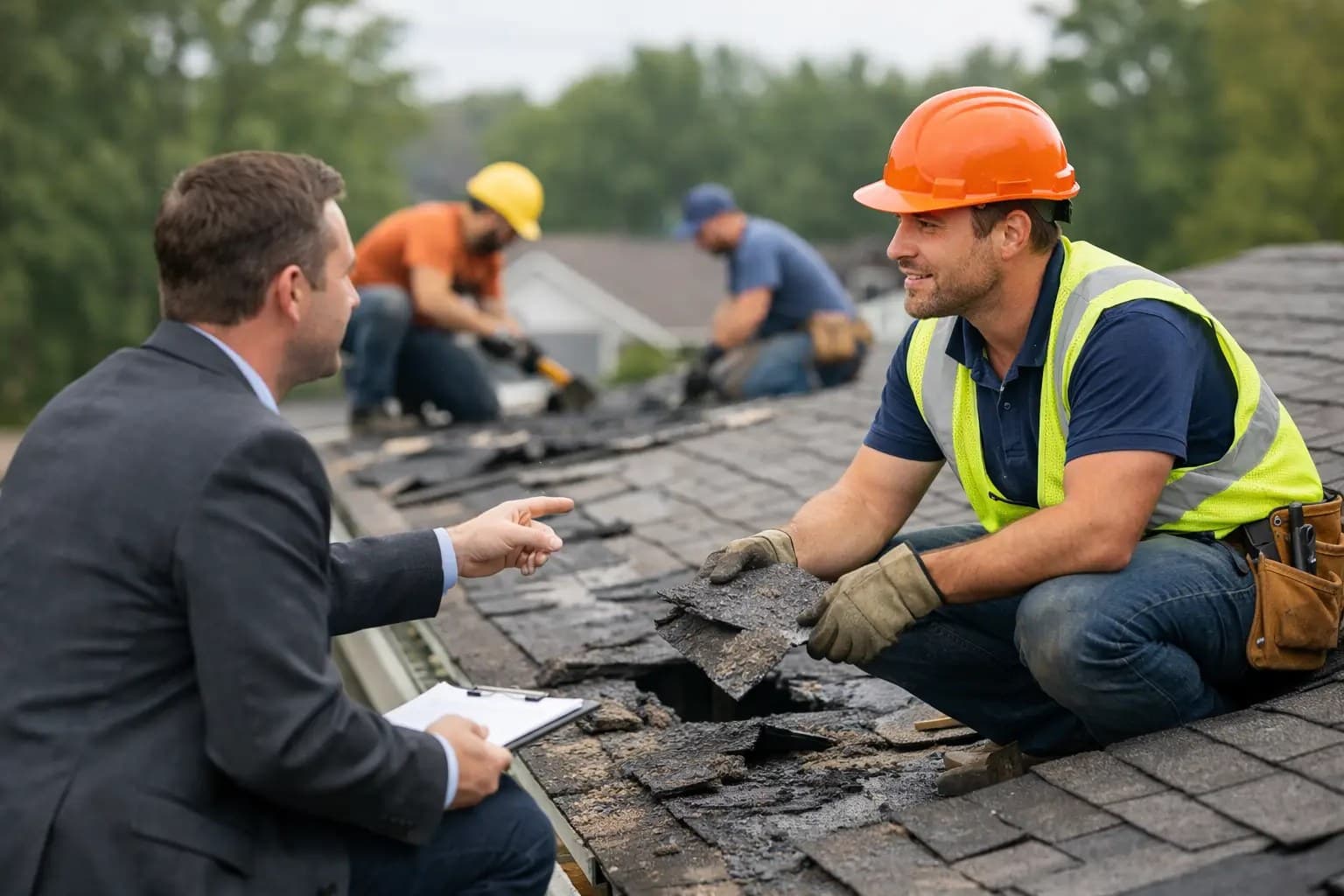
A storm comes through, the shingles end up in the yard, and within a day you are expected to talk like a contractor, an adjuster and a policy expert at the same time. Most people are none of those things, which is exactly why the roles are worth separating before anyone knocks on your door.
There is a hard line running through this, and it is drawn by state law rather than by company policy. Understanding where it sits will tell you, within about thirty seconds, whether the roofer standing in your driveway is worth listening to.
The line, and who drew it
Minnesota Statute 325E.66 says a residential contractor may not interpret policy provisions, may not advise an insured about coverage or about duties under a policy, and may not adjust a claim on the insured's behalf, unless that contractor is also licensed as a public adjuster. The same statute makes it illegal for a residential contractor to pay, waive, rebate or absorb any part of an insurance deductible.
Roofs R Us is a roofing company. We hold Minnesota license BC740619. We are not licensed as public adjusters, so everything on the insurance side of that line belongs to your agent, your carrier, and the Minnesota Department of Commerce, which regulates them.
That is not a limitation we are apologizing for. It is the reason a roofer's promises about your policy are worth nothing: they are being made by someone with no standing to make them, about a document they have not read.
What a roofing contractor actually does after a storm
This part is substantial, and it is the part that matters for your house.
A real inspection, with fall protection
Someone gets on the roof. Not a walk around the yard and a verdict, an actual inspection of every slope. Hail damage is often a bruise rather than a hole, close to invisible from the ground, so it has to be found at close range. Larger or wind-driven stones can tear or puncture a shingle outright. What a bruise looks like: granules scattered at the point of impact, the fiberglass mat fractured underneath, the exposed asphalt still dark rather than weathered.
We check the soft metals first, because they are unambiguous. Aluminum gutters, downspouts, vent caps, roof jacks and the furnace flue take a dent and keep it, so they show the size of the stones and the direction they arrived from. We check the flashing at chimneys, sidewalls, valleys and skylights, because that is where most leaks actually start. We check the ridge, the field, the penetrations and the pipe boots. Then we go into the attic and look at the underside.
Documentation you can hold
You get photographs and a written report: which slopes are affected, what we found on each one, the age and condition of the shingle, what is worn rather than struck, and where any water is getting in. Storm damage and ordinary aging often sit on the same roof, and the report says which is which rather than blurring them together.
That report belongs to you. Take it to your agent, take it to a second roofer, keep it in a drawer. It is useful in every version of what happens next, including the version with no claim in it at all.
An itemized estimate
Tear-off, disposal, deck repair, underlayment, ice and water shield, drip edge, starter, flashing, ventilation, ridge, the shingle itself, labor. Line by line, with quantities, so the number can be checked rather than taken on faith. A lump-sum figure on the back of a card is not an estimate.
Attendance at the adjuster visit
If you want us at the inspection, we will be there. Not to argue on your behalf, which we are not permitted to do, but to answer construction questions on the spot: what a particular dent means, how that valley was built, what is under the shingles on the north slope, why the flashing at the chimney is doing what it is doing. Technical questions get technical answers, from the person who will be doing the work.
The build
Then the actual job: permits pulled, the deck inspected once the old roof is off, code items done properly, the manufacturer's system installed the way the warranty requires, and the site cleaned up. As an Owens Corning Platinum Preferred contractor we register the workmanship and material warranty in your name before the crew leaves.
What we will not do
We will not interpret your policy or tell you what it covers. We will not predict what your insurer will decide. We will not advise you on filing, on timing, or on any duty you have under your policy. We will not speak to your insurance company as your representative. And we will not pay, rebate or absorb any part of your deductible.
If a roofer offers to do any of that, you have learned something useful. Either they do not know the law, or they know it and have decided it does not apply to them. Neither is a person you want on your roof with a nail gun and a warranty.
What only your agent or carrier can do
The insurance half has its own order, and the Minnesota Department of Commerce publishes it.
Commerce says the first step after a loss is to call your insurance agent and report it, or the insurance company directly if you do not have an agent. After that, Commerce tells homeowners to make sure the area is safe, to take pictures or video before cleaning up, to avoid throwing anything out until they meet with the adjuster, and to make temporary, inexpensive repairs to prevent further damage while keeping the receipts for materials so they can be reimbursed.
Commerce also says not to call anyone to repair or replace your loss without first getting instructions from your insurance company's adjuster, since the insurer may need to inspect first. When the adjuster arrives, Commerce says to ask for identification, for what you are required to do next, for what the company will be doing next, for instructions on getting repair estimates, and for a time estimate on the process.
If there is a disagreement, Commerce says to ask for the specific policy language in question, and if a claim is denied, to ask for a written explanation naming the reason and the policy language behind it. Commerce says not to rush into a settlement that does not meet your expectations, and notes that you may hire a public adjuster, who is typically paid a percentage, though you are not required to use one. Check their registration with Commerce first and get a written contract identifying all fees.
All of it is at mn.gov/commerce, and it is better read at the source than summarized by a roofing company.
How to tell a real inspection from a sales call
Both take about the same amount of your afternoon. They look nothing alike.
- A real inspection puts someone on the roof, safely, on every slope. A sales call is a walk around the yard.
- A real inspection produces photographs of specific locations. A sales call produces a verdict.
- A real inspection distinguishes storm damage from age. A sales call finds storm damage on every roof it visits.
- A real inspection leaves you with a written report and an itemized number. A sales call leaves you with a contract to sign today.
- A real inspection talks about the roof. A sales call talks about your policy.
Commerce publishes its own warning signs, and they travel well: be wary of anyone who claims to be from a government agency, insists their services are mandatory, uses high-pressure sales tactics, or refuses to provide a written contract. Our storm chaser red flags guide covers the rest.
What to check before you hire anybody
- A Minnesota residential contractor license number, checked at the Department of Labor and Industry rather than taken on trust.
- A physical local address that is not a motel or a truck.
- Proof of general liability insurance and workers compensation, sent to you by their agent rather than shown on a phone.
- A written contract with a full scope, a real price and no blank spaces.
- Manufacturer credentials that can be verified with the manufacturer.
- Local references from this year, at addresses you could drive past.
Roofs R Us has been in Blaine since 2000 and BBB A+ accredited since 2008. Ask for a free roof inspection and we will bring you photographs and an itemized number, whoever ends up paying for the work. Our storm damage page covers what the job itself involves.
← Back to all posts