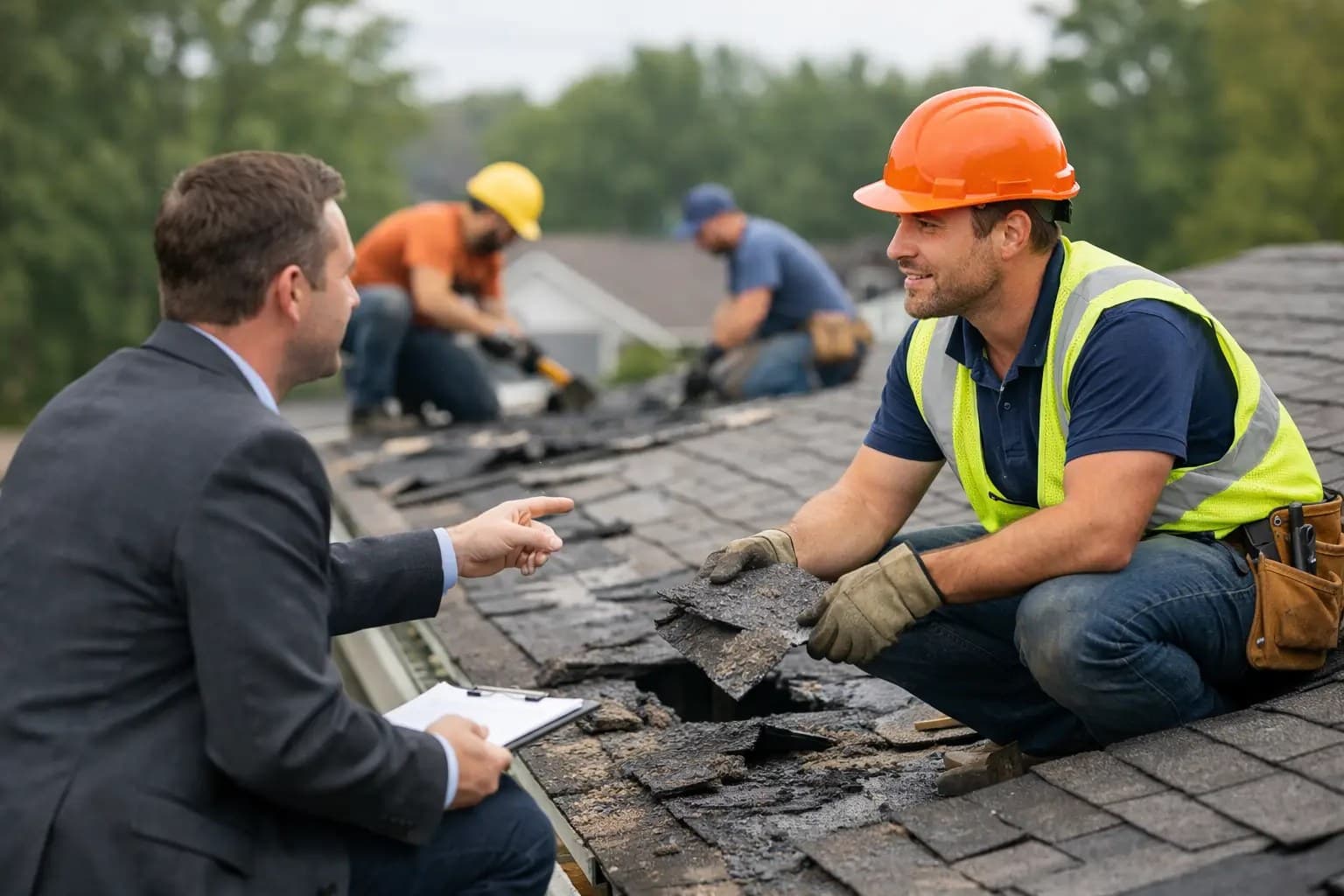
A brown ring appears on the ceiling, and two questions arrive at the same time. What is coming apart up there, and who pays for it?
We can answer the first one properly. We cannot answer the second one at all, and it is worth explaining why before you read any further, because plenty of roofing websites will happily answer it for you and they should not.
Whether a particular leak sits inside your policy is a question about a document we have never seen, written by a company we do not work for. Minnesota Statute 325E.66 says a residential contractor may not interpret policy provisions, may not advise an insured about coverage or about duties under a policy, and may not adjust a claim, unless that contractor is also licensed as a public adjuster. We are a roofing company, so that question belongs with your agent or your carrier.
Here is what we can give you: why Minnesota roofs actually leak, how to find where the water is getting in, what to do tonight so the damage stops growing, and what the repair costs when you are the one paying. That is the half of the problem that decides how bad this gets.
First, the order the state recommends
The Minnesota Department of Commerce publishes guidance for homeowners after a property loss, and it is short and specific.
Commerce says the first step is to call your insurance agent and report the loss. If you do not have an agent, call the insurance company directly. After that, Commerce tells homeowners to make sure the area is safe, to take pictures or video before they start cleaning up, and to make temporary, inexpensive repairs to prevent further damage. Commerce gives putting a tarp over a damaged roof as one of its own examples, and says to keep the receipts for materials you buy so you can be reimbursed.
Commerce also says something a lot of homeowners get backwards: do not call anyone to repair or replace your loss without first getting instructions from your insurance company's adjuster. You can read all of it at mn.gov/commerce.
An inspection is not a repair. Having a roofer come look at the roof and photograph what is there is information, and information is what everyone in this process is about to ask you for.
What to do tonight, while the water is still moving
Water in a house does not wait for anybody, so start here.
- Move what you can out from under it, and put a bucket where the drip lands.
- If the ceiling is bulging, put a container underneath and poke a small hole at the low point with a screwdriver. That sounds wrong. It is not. A controlled drip through one hole beats the whole sheet of drywall letting go at once.
- Photograph everything before you clean up. The stain, the bucket, the attic, the wet insulation, the yard.
- Get into the attic with a flashlight if it is safe to do so, and look for daylight, wet sheathing, or a wet run down a rafter.
- Do not get on the roof. A wet Minnesota roof with loose granules on it is one of the more reliable ways to end up in an emergency room.
Why Minnesota roofs actually leak
In our experience across the north metro, most leaks come from one of six places, and only two of them are the shingles.
Flashing
Flashing is the metal that seals the joints: around the chimney, along a sidewall, in a valley, at a skylight. It is the single most common source of a leak we get called for. Flashing fails because it was installed short, because someone caulked it instead of stepping it properly, or because thirty freeze and thaw cycles a year have worked it loose. A roof can have a perfectly good shingle field and still leak at a chimney.
Pipe boots
The rubber collar around your plumbing vent has a shorter life than the roof does. Ultraviolet light hardens it, the rubber splits at the pipe, and water runs straight down the outside of the pipe into the attic. On a fifteen-year-old Twin Cities roof, cracked boots are close to routine. It is also one of the cheapest repairs there is.
Ice dams
This one is ours specifically. Heat escapes into the attic, the snow on the warm part of the roof melts, the water runs down to the cold overhang and refreezes into a ridge of ice. Everything behind that ridge backs up and finds its way under the shingles, because shingles shed water, they do not hold it. Ice dam leaks show up in January and February, usually at an exterior wall, and the real fix is attic insulation and ventilation rather than anything on the roof surface.
Storm-created openings
Wind breaks the seal strip between shingle courses, the shingle lifts and creases, and the mat is broken along the fold. Hail often bruises a shingle, scattering the granules and fracturing the fiberglass mat underneath, and larger or wind-driven stones can tear or puncture it outright. Neither one necessarily leaks the same day. Both can open a path that leaks quickly, much later, or never, depending on how bad the damage is and what the weather does next, which is why a stain in July can sometimes trace back to a storm in May.
Old shingles at the end of their run
An asphalt roof in Minnesota gives you somewhere around twenty to thirty years depending on the shingle and the ventilation under it. Near the end, the mat gets brittle, the corners curl, granule loss accelerates and the roof simply stops being waterproof. There is no single failure point to repair. The roof is finished.
Condensation, which is not a leak at all
Worth knowing before you call anyone. If your attic is poorly ventilated, warm moist household air hits the cold underside of the sheathing and condenses there. It drips, it stains the ceiling, and it looks exactly like a roof leak. The tell is that it appears in cold weather without any rain, and it is spread out rather than tracking to one point. The fix is ventilation, not shingles.
How to find where the water is getting in
Water does not fall straight down through a roof. It gets in at one point, runs along the top of the sheathing or down a rafter until it hits something, and drips there. The entry point is almost always uphill of the stain, sometimes by ten or fifteen feet.
That is why finding a leak from inside the house rarely works, and why we start in the attic with a flashlight and then go up top and look at what is directly above the wet run. It is also why a repair aimed at the stain instead of the source fixes nothing and costs you twice.
Repair or replace
This is a building question with real answers, entirely separate from who pays.
A repair usually makes sense when the source is a single component such as a boot, a section of flashing or one area of storm damage, when the shingle line is still made so the patch will match, and when the surrounding shingles are still flexible enough to lift without cracking. That last condition rules out most repairs on an old roof: on brittle shingles you break three getting at the nails for every one you meant to replace.
A replacement is usually the answer when the leak is one symptom of a roof that has aged out, when the shingle is discontinued so nothing matches, or when damage is spread across several slopes and patching one area only moves the next leak somewhere else.
We will tell you which one your roof is, in writing, with photographs of what we found. If it is a repair, we will say so. There is more money in the other answer and we will still say so.
What it costs when you are paying
Worth knowing regardless of how the rest goes. A targeted roof repair in the Twin Cities generally runs from a few hundred dollars for a pipe boot or a small flashing correction up into the low thousands for a larger section, and a full asphalt replacement on a typical metro house runs from around $9,000 on a small rambler to the mid twenties on a large two-story. Our Twin Cities cost guide breaks the ranges down by house type, and how to pay for a new roof in Minnesota covers financing through Acorn: up to $100,000, fixed rates, more than thirty lenders, terms out to twenty years, subject to credit approval.
What we do, and what we will not do
What we do. Find the source of the leak and photograph it. Give you a written report and an itemized estimate. Be there when your adjuster visits, if you want us there. Answer construction questions about the roof, the flashing, the deck and the ventilation. Build the work you hire us to perform.
What we will not do. Interpret your policy or tell you what it covers. Predict what your insurer will decide. Advise you on filing, on timing, or on any duty you have under your policy. Pay, rebate or absorb any part of your deductible, which Minnesota Statute 325E.66 makes illegal for every residential contractor in this state.
Roofs R Us holds Minnesota license BC740619 and has been BBB A+ accredited since 2008. If there is water coming into your house, get us out to look at it.
← Back to all posts