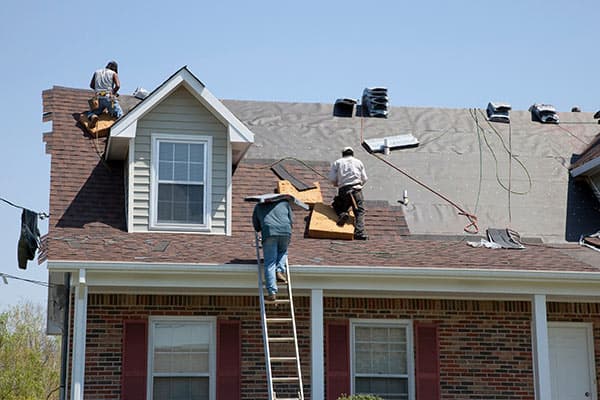
If you ask five roofers what a new roof costs in Minneapolis, you get five ranges, and none of them tell you what your house costs. That is because the number is not really about the city. It is about the shape and age of the house, and the Twin Cities has four or five house types that account for most of what we roof.
So this guide prices it that way. I'm Luke, and we replace roofs across Minneapolis, St. Paul, Bloomington, and Brooklyn Park from our shop in Blaine. Below are the 2026 numbers by house type, the old-house surprises that move them, and what a legitimate quote has to include in this climate.
Need this handled? See our roof replacement service.
Roof Replacement in the Twin CitiesThe 2026 baseline for the metro
Roofers price by the square, which is 100 square feet of roof surface. In 2026, installed asphalt roofing in the Twin Cities runs roughly $450 to $1,000 per square, or $5 to $8 per square foot for a laminated architectural shingle, which is what belongs on nearly every house here. Class 4 impact-resistant shingles run $7 to $10 per square foot; our Class 4 guide covers when the upgrade is worth it, and whether an impact-resistant roof matters to your own insurer is a question for your agent.
Those per-square numbers already include tear-off, disposal, underlayment, ice-and-water shield at the eaves, drip edge, new pipe boots and flashing, ridge vent, cleanup, and the permit. What moves a house up or down the range is pitch, complexity, layers, decking, and access. Here is how that plays out on the houses we actually see.
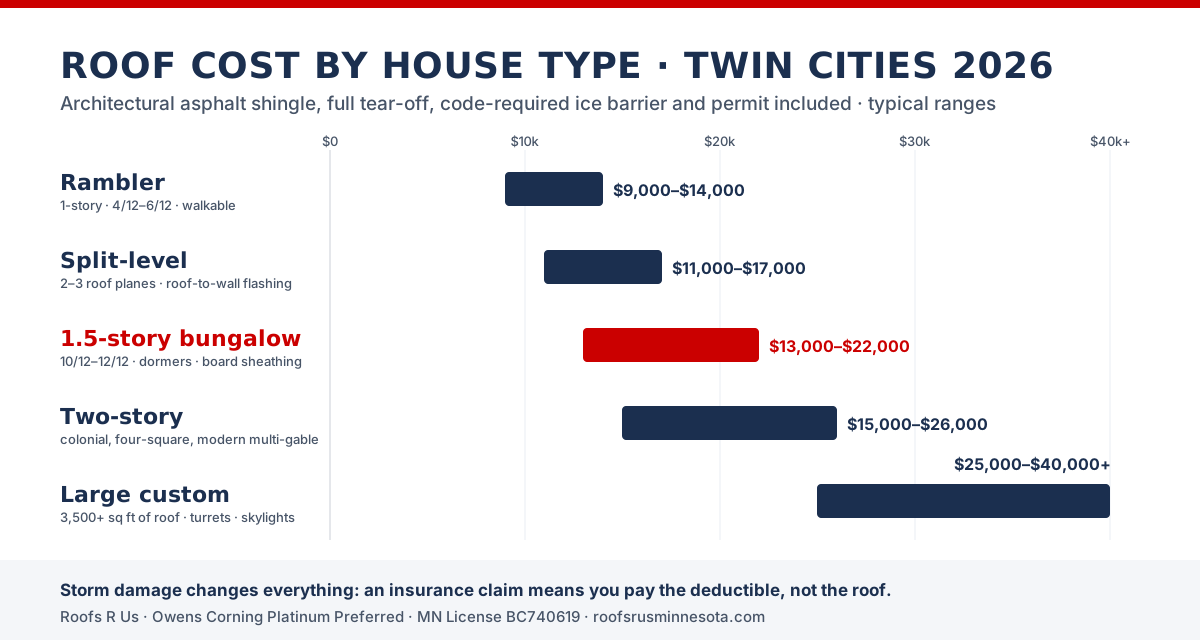
The rambler: $9,000 to $14,000
The one-story rambler is the backbone of Bloomington, Brooklyn Park, Richfield, Roseville, and the first-ring suburbs built from the 1950s through the 1970s. Simple gable or hip, 4/12 to 6/12 pitch, roughly 1,600 to 2,200 square feet of roof, one or two plumbing vents, maybe a chimney.
This is the cheapest roof in the metro to replace, and the fastest. A crew can walk the whole thing, there are few valleys, and the roof is usually done before lunch. Most ramblers land between $9,000 and $14,000 with an architectural shingle. Attached garages and breezeways add square footage but little complexity.
What pushes a rambler up: a second layer of shingles to tear off, or a low-pitch section over an addition that needs different underlayment.
The split-level: $11,000 to $17,000
Split-levels and split-entries filled in Brooklyn Park, Blaine, Coon Rapids, and Maplewood in the 1970s and 1980s. Two or three roof planes at different heights, usually 5/12 to 7/12 pitch, about 1,900 to 2,500 square feet of roof.
The extra cost over a rambler is the roof-to-wall intersections where the upper section meets the lower, which need step flashing and kick-out flashing done right, and the fact that the crew is working on two levels. Typical range: $11,000 to $17,000.
What pushes a split up: the lower roof over the garage was often built at a shallower pitch than the house and is where ice dams and rot show up.
The 1.5-story bungalow: $13,000 to $22,000
This is the Minneapolis and St. Paul house. Longfellow, Nokomis, Highland, Mac-Groveland, the Midway, the North End: block after block of 1920s to 1940s bungalows and story-and-a-halfs with steep 10/12 to 12/12 roofs, a shed or gable dormer on one or both sides, and an upstairs that was finished into the roof.
The roof is not large, often only 1,500 to 2,000 square feet. It is slow. A 12/12 roof cannot be walked, so everything is done from staging and roof jacks. Dormers add valleys, sidewall flashing, and cut-up sections that eat labor. And under the shingles, these houses hide the surprises I cover below. Realistic range: $13,000 to $22,000, and the top of that range is not unusual on a house with two dormers and three old layers.
What pushes a bungalow up: board sheathing, multiple layers, cedar shakes under the asphalt, a brick chimney that needs new counterflashing cut into the mortar, and a tight lot where the dumpster goes in the alley.
The two-story: $15,000 to $26,000
Colonials, four-squares, and the newer two-stories in Bloomington, Eagan, Woodbury, and the outer suburbs. Roof area of 2,200 to 3,200 square feet, pitch from 6/12 on a four-square to 9/12 or more on a modern multi-gable. The height adds safety setup and material handling time, and newer two-stories often have a lot of roof planes, valleys, and a front-facing gable or two.
A simple older two-story with a hip roof can come in near $15,000. A large new-construction two-story with eight valleys and a three-car garage can run $26,000 or more with an architectural shingle. Our Blaine cost guide covers the suburban version of these homes in more detail.
The big custom or multi-gable: $25,000 to $40,000+
Lakeshore homes, the large lots in Edina and Plymouth, and anything with more than 3,500 square feet of roof, multiple pitches, turrets, or a lot of skylights. These are quoted individually and the range is wide. The thing to know is that the shingle is a small share of the bill on these houses. It is the flashing, the valleys, and the labor.
The old-house surprises that move the number
The Minneapolis and St. Paul housing stock is old, and old roofs hide things. A good quote names the price of each of these up front so there is no argument on tear-off day.
Board sheathing. Houses built before about 1960 usually have 1x6 or 1x8 boards for decking instead of plywood, often with gaps between them, and sometimes it is skip sheathing spaced for the original cedar shakes. Shingles cannot be nailed to gaps. The fix is either overlaying with new OSB or plywood across the whole roof, or replacing individual bad boards. On a bungalow, a full overlay can add $2,000 to $5,000.
Multiple layers. Minnesota code allows two layers of shingles. Older city houses often have two, and I have torn off three with cedar shakes under all of it. Every extra layer is more labor and a heavier dumpster. Ask your roofer what the quote assumes and what the per-layer price is if there are more.
Rotted decking. Ice dams over decades do their work. Soft or delaminated decking gets replaced by the sheet, and a good contract states that per-sheet price before the job starts. Budget for a few sheets on any roof over 25 years old.
Chimneys. A brick chimney needs step flashing and counterflashing cut into the mortar joints, not smeared with tar. If the chimney crown is cracked or the brick is spalling, that is masonry work, and it should be done before the new roof goes around it.
Access. A South Minneapolis lot with a detached garage on the alley and no driveway means the dumpster and the shingle delivery both go in the alley, and the crew carries everything. That is time, and it shows up in the quote.
What Minnesota code requires in the quote
Every legitimate Twin Cities quote should include, in writing:
- Ice-and-water barrier from the eave to at least 24 inches inside the exterior wall line, plus valleys and around penetrations. Minnesota requires it, and on a bungalow with a heated upstairs it is your only backup against ice dam backup.
- A permit and final inspection from the city. Minneapolis and St. Paul both require them.
- Full tear-off to the deck, with the number of layers assumed.
- Synthetic underlayment, new drip edge, new pipe boots, new step and counterflashing, and ridge ventilation sized to the attic.
- The exact shingle, by brand and line, and both warranties: manufacturer and workmanship.
If one quote is thousands below the rest, this list is where the money came out.
When a storm is involved
A large share of the roofs we replace in the metro follow a storm rather than a decision. The June 19 storm ran through the north metro, and earlier events have hit South Minneapolis and St. Paul.
How your own carrier settles a roof loss is not something we can tell you. Minnesota Statute 325E.66 bars a residential contractor from interpreting policy provisions or advising an insured about coverage, unless licensed as a public adjuster, and we are not. Your agent or your carrier can answer it, and the Minnesota Department of Commerce publishes homeowner guidance at mn.gov/commerce. Two useful questions to put to your agent: how does my policy settle a roof, and what is my deductible on this kind of loss. Ask for the answers in writing.
What we can do is get a documented inspection in your hands, which is worth having either way, because hail often bruises a shingle rather than holing it, and a bruise is not visible from the ground. Larger or wind-driven stones can tear or puncture outright. Our guide to what a contractor can and cannot do and our roof age guide cover the rest.
And if you are paying, most people do not write one check. Our how to pay for a new roof guide walks through insurance, fixed-rate financing through Acorn Finance, and paying cash.
Want the number for your house, not a house type? Request a free estimate and we will measure it, check it for storm damage while we are up there, and give you a line-item quote with the decking and layer prices stated up front. See our roof replacement service or the Minneapolis and St. Paul service area pages for what we do in your neighborhood.
← Back to all posts