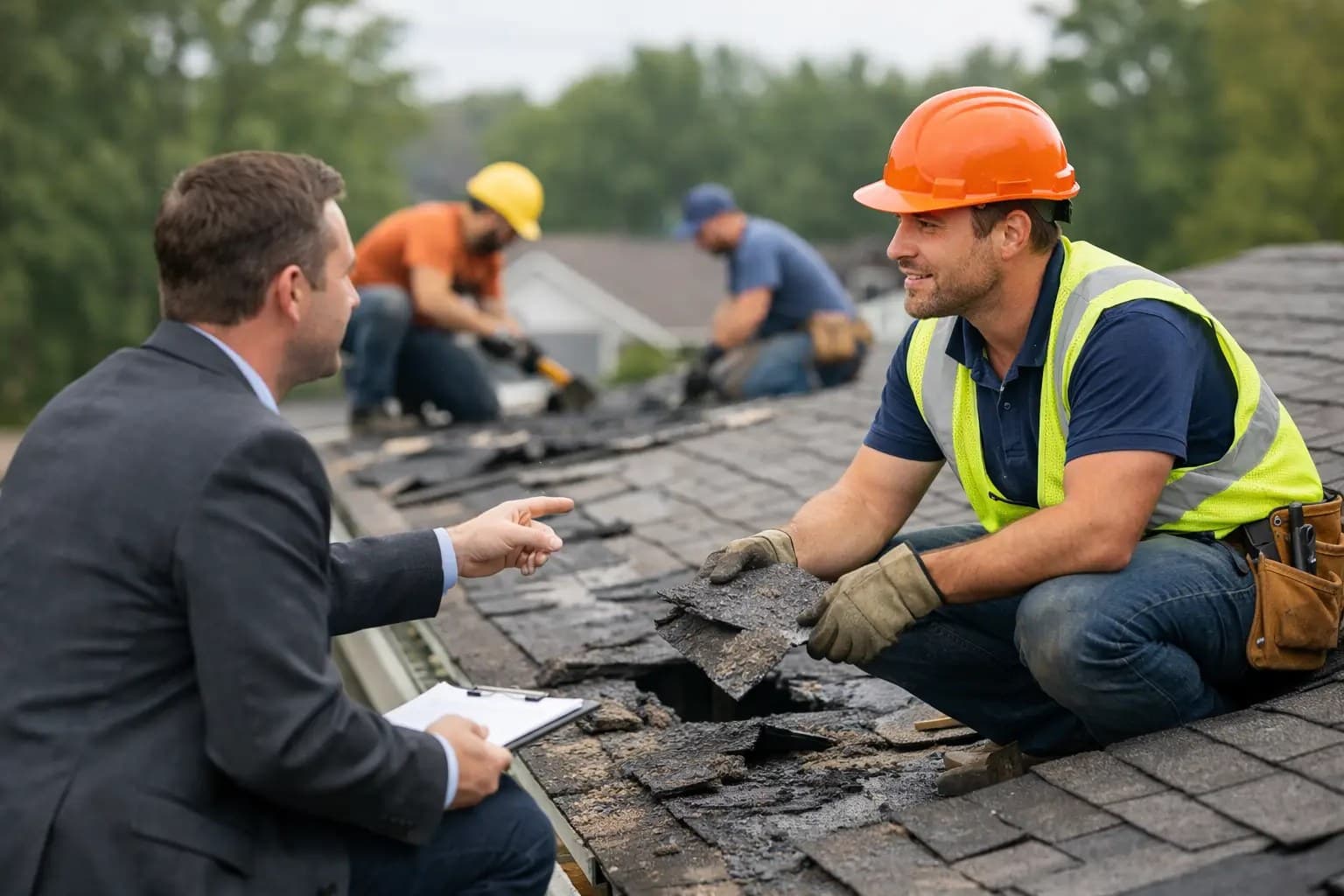
A storm comes through, shingles land in the yard, and within a day or two somebody is on your step with a clipboard. Choosing well at that moment matters more than almost any other decision in the project, and the usual advice (get three quotes) is not much help when all three people are telling you what you want to hear.
This is how to judge a storm restoration roofer on things you can actually check.
First, the line no contractor may cross
Start here, because it disqualifies people quickly.
Minnesota Statute 325E.66 bars a residential contractor from interpreting policy provisions, from advising an insured about coverage or about duties under a policy, and from adjusting a claim on the insured's behalf, unless that contractor is also licensed as a public adjuster. The same statute makes it illegal for a residential contractor to pay, waive, rebate or absorb any part of an insurance deductible.
So a roofer who tells you how your claim will go, offers to take the claim off your hands, or offers to take care of your deductible is not being generous. They are either unaware of the law or working around it, and both tell you what the rest of the job will look like. Roofs R Us is a roofing company, license BC740619, and we are not public adjusters. Anything about your own policy belongs with your agent or your carrier.
Inspection quality, which is the whole ballgame
Everything downstream depends on whether anyone actually looked at the roof.
A real inspection puts someone on every slope with fall protection. It checks the shingle field at close range, because hail often bruises a shingle rather than holing it, and a bruise is close to invisible from the ground. Larger or wind-driven stones can tear or puncture outright. It checks the soft metals first, because aluminum gutters, downspouts, vent caps and the furnace flue take a dent and keep it, which tells you the stone size and the direction the storm came from. It checks the flashing at chimneys, sidewalls, valleys and skylights, since that is where most leaks actually begin. Then it goes into the attic and looks at the underside of the deck.
What you should get back is a written report with photographs of specific locations, and a plain statement of which damage came from the storm and which is ordinary aging. Both often sit on the same roof, and a contractor who blurs them together is not doing you a favor.
If someone walks the yard, looks up, and delivers a verdict, you have watched a sales call rather than an inspection. If they find storm damage on every house on the street, that is not thoroughness, it is a business model.
The estimate
Ask for it itemized, with quantities. Tear-off, disposal, deck repair, underlayment, ice and water shield, drip edge, starter course, flashing, ventilation, ridge, the shingle itself, labor. Written that way the number can be checked. Written as one figure on the back of a card, it cannot.
Two estimates can look close at the bottom line and be completely different in the middle: a synthetic underlayment versus felt, six nails per shingle versus four, new flashing versus reusing the old, ice and water shield to code versus a single course. Compare the middle.
The lowest number is not automatically the worst one, but a number well below the others usually means something has been left out rather than that someone found efficiencies. Ask what.
What to verify before you sign anything
- A Minnesota residential contractor license number, checked with the Department of Labor and Industry rather than taken on trust.
- A physical local address that is not a motel, a PO box or a truck.
- General liability insurance and workers compensation, with the certificate sent to you directly by their agent.
- Manufacturer credentials confirmed with the manufacturer, not just a logo on a van. Owens Corning Platinum Preferred, for instance, is verifiable and it changes what warranty you can actually receive.
- A written contract with a full scope, a real price, and no blank spaces to be filled in later.
- Local references from this year, at addresses you could drive past.
Minnesota specifics that separate the locals from the visitors
Climate does most of the work here. A contractor who understands this market talks about ice and water shield coverage at the eaves, about attic ventilation and ice dams, about freeze and thaw cycles hardening asphalt, and about what a shingle actually does in its fifteenth Minnesota winter.
A visiting crew talks about the storm. Ask a ventilation question and watch what happens.
What the process usually looks like
If storm-related damage is found, the next step is yours, not your roofer's. The Minnesota Department of Commerce says the first step after a loss is to call your insurance agent and report it, or the insurance company directly if you do not have an agent. Commerce publishes its full homeowner guidance at mn.gov/commerce.
Your contractor's part is to hand you the documentation and to be present at the inspection if you want them there, so that construction questions get answered by someone who builds roofs. What happens with the claim itself is between you and your carrier.
Once you know what you are doing, the contractor's job resumes: materials selected, permits pulled, schedule confirmed, the deck inspected when the old roof comes off, code items done properly, and the site left clean. A contractor who can also handle gutters, siding, soffit and fascia saves you coordinating three companies when a storm hit more than the shingles.
Trade-offs worth understanding
Speed cuts both ways. After a major storm everybody wants somebody on the roof tomorrow, and a contractor who can inspect quickly is genuinely useful. A contractor who wants a signature the same afternoon is not the same thing.
Scope cuts both ways too. Overstating damage to chase a bigger job creates its own problems, and understating it to win on price leaves you with a roof that fails early. What you want is a contractor whose written findings match what the photographs show, and who will say plainly when a repair is the right answer even though a replacement pays better.
Warning signs
Be cautious with a contractor who offers to waive your deductible, which is illegal in this state, or who pressures you to sign before you are comfortable, or who promises you an outcome from your insurer that is not theirs to promise.
Be wary of vague paperwork. You should get a clear written estimate or agreement that explains material options and states what is and is not included. If the language feels slippery, the project usually is.
Be wary of poor follow-through. If a contractor is hard to reach before the job starts, that rarely improves once schedules and installation details are in play.
The Minnesota Department of Commerce publishes its own warning signs for people who turn up after a disaster: be careful of anyone who claims to be from a government agency, insists their services are mandatory, uses high-pressure sales tactics, or refuses to provide a written contract. Our storm chaser red flags guide goes further.
What good actually looks like
A contractor worth hiring inspects carefully, documents thoroughly, prices in the open, explains what they are doing in language you can check, builds it properly, and stands behind it afterwards. They talk about your roof rather than your policy, and they are comfortable telling you something you did not want to hear.
Roofs R Us has been in Blaine since 2000 and BBB A+ accredited since 2008. Ask for a free roof inspection and we will bring you photographs, a written report and an itemized number.
← Back to all posts